viernes, 3 de mayo de 2019

Magic and tricks with maths

The mathematical trick to make calculations more easily than it went viral (and that nobody taught us in school)


Do you also run for the calculator every time you have to calculate a percentage? Well, advertising editor Ben Stephens posted on Twitter a trick you wish you had known all your life.

The ingenious formula proposed by the tweet to calculate percentages is the following: x% of y = y% of x.


Thus, following the example of Stephens, 4% of 75 is equal to 75% of 4, with the difference that investing the numbers is much easier to calculate. The answer, in this case, is 3.

Let's do another test. It is likely that it will be difficult for you to calculate mentally and with speed 18% of 50. But applying the formula that Stephens viralized, we know that 18% of 50 equals 50% of 18. And 50% of 18 is 9, much easier to calculate, right?

The tweet already has almost 6,500 retweets and more than 18,000 likes.

In another post, Stephens himself acknowledged that he did not expect it to go viral: "Typical, I spend years tweeting about important things about Trump and Brexit, and then I publish a tweet about mathematics (a topic I had never tweeted before) and the internet goes crazy. "

Many users of the social network thanked him for discovering a trick that they say will be useful to them.

BBC: "El truco matemático para hacer cálculos más fácilmente que se hizo viral (y que nadie nos enseñó en la escuela)" (12 de marzo de 2019). Extraído de: https://www.bbc.com/mundo/noticias-47540941

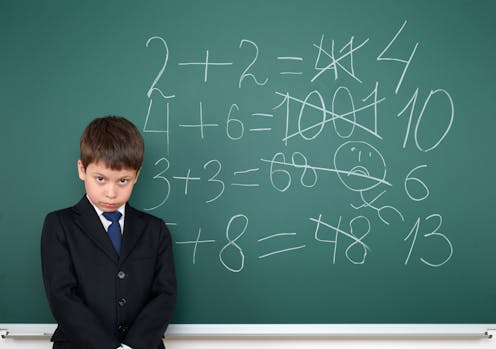
Dyscalculia, the 'mathematical dyslexia'

It is very likely that you have heard of dyslexia, but do you hear about a disorder called dyscalculia? Surely not, since children who suffer difficulties in learning mathematics are not diagnosed with the same frequency as those who have dyslexia.

In fact, our recent study in the United Kingdom shows that students with dyslexia are more than 100 times more likely to obtain a diagnosis and educational support than children with dyscalculia, despite the fact that both disorders are considered to be just as common.

What is dyscalculia?

Dyscalculia is defined as a disorder characterized by severe difficulties in learning long-term mathematics, which cause considerable problems in academic or work performance, as well as in daily activities.

Some of the typical symptoms of dyscalculia, easily identifiable by parents, are finger counting (even in simple operations), the difficulty of remembering numerical data (such as multiplication tables) and the need to overexert themselves to acquire new knowledge.


Resultado de imagen de discalculia

Como abordar la discalculia, la "dixlesia matemática" (4 de febrero de 2019). Extraído de: https://www.vozpopuli.com/altavoz/next/abordar-discalculia-dislexia-matematica_0_1215478907.html

lunes, 29 de abril de 2019

Mathematics synonymous with work in Spain

They say that a mathematical truth is not simple or complicated, it is simply a truth. The first study that measures the impact of this science on the economy accumulates all the value of the small truths it brings.

In Spain, the occupations and products that use mathematics generate an impact of one million employed persons, 6% of total employment in the economy and a gross added value of 103,000 million euros, 10% of the Spanish GVA.

Computing, financial services and insurance, telecommunications, energy are sectors that use mathematics intensively, although the magnitude of these impacts is lower than that measured in other European countries where similar studies have been carried out.

Mathematics generates fear and insecurity among those who are not used to solving problems. But the initiatives to incorporate them into the daily life of companies and increase their contribution to the economy are not limited to studies.

Despite these data, Spain still has a lot of work to do to get at the same level as the rest of Europe in question at the level of imporantancia that is given to mathematics.

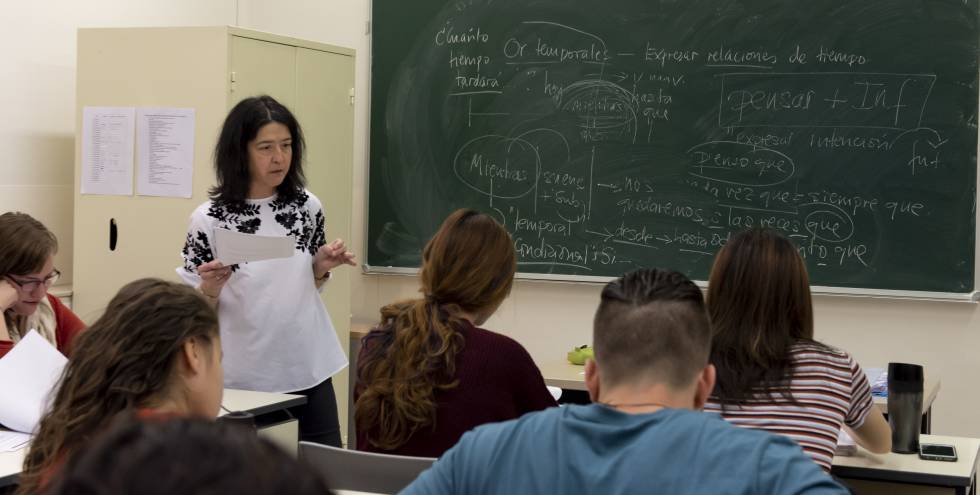
Clase de la universidad de Salamanca.  rn