lunes, 27 de mayo de 2019

The wonderful lesson of a 7 year old child to his teacher

Impeccable, funny and intelligent. This is how a seven-year student solved a mathematics exercise. It is not the first time, nor the last, that an ambiguous statement brings out a teacher through a wonderful (future) mind.

His name is Jaime, he is seven years old and he is a crack. Who knows if a new Euclid, Newton or Gauss, ... or, sweeping for home, Echegaray, Torroja or Catalá, ...

The fact is that Jaime's father, a mining engineer, wanted to share on Twitter the wonderful work of his son. A mathematics exercise impeccably solved (except for some clueless teacher).

Even at first glance it is difficult to identify Jaime's genius. The same thing that should have happened to his teacher. The answer is not correct when it is the same exercise (with a bad statement) that you have put throughout your life to thousands of students who have answered the same.

'The following numbers' can also mean 'the numbers correlative to those proposed in the statement', and that is what Jaime interpreted, writing them in figures.
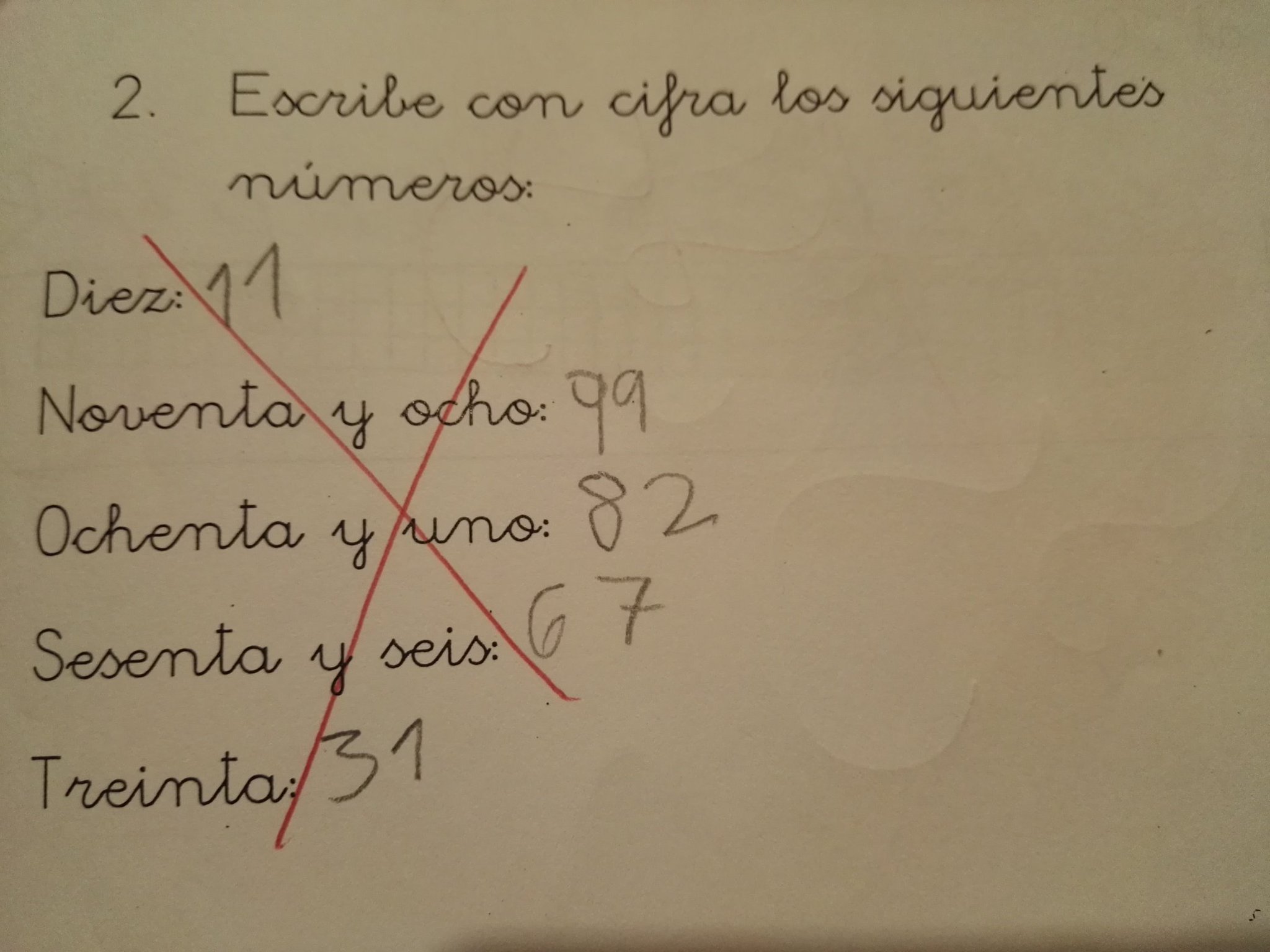


The tweet has been viralized in hours. More than 13,000 shares and 22,000 likes for an account with few updates. The proof that the reader sympathizes with an intelligent student and capable of seeing and interpreting reality in an original and different way than the majority does.

"We teach children to hate mathematics before we start studying them"

The Sevillian Clara Grima is a reference in the dissemination of mathematics. His crusade to combat hatred of numbers now comes in the form of a freaky book, "May Mathematics Be with You!"

If you follow closely the agenda of the mathematics and disseminator Clara Grima understands why the screenwriters of a certain television program baptized her in her day as the "red whirlwind". In addition to his classes at the University of Seville, he organizes lectures, lectures, awards, participates in plays and is behind some of the most successful scientific dissemination initiatives in Spanish. In a few years, the tireless work of this PhD in Mathematics has done more to improve the image of this discipline than many institutions.

“Enseñamos a los niños a odiar las matemáticas antes de empezar a estudiarlas”

4 colors = a map

Is it true that 4 colors are enough to paint any map without any neighboring country having the same color? The question seems banal, but the enigma has overshadowed more than one great mathematical mind and until recently it could be solved. Can you?

How many colors are really needed to paint a map so that no country is left with the same color? It is very likely that this question has never been raised, and that it seems to be an issue of exclusive interest to the cartographers.

However, that question, so simply described but so difficult to prove, was for more than a century one of the most difficult to solve in mathematics, and put to the test some of the most imaginative minds, including that of the mathematician and author of "Alice in Wonderland", Lewis Carrol. And it turns out that, mathematically, the answer is 4.


¿Es cierto que 4 colores son suficientes para pintar cualquier mapa sin que ningún país vecino tenga el mismo color? ¿Y por qué importa?

Semana: ¿Es cierto que 4 colores son suficientes para pintar cualquier mapa sin que ningún país vecino tenga el mismo color? (31/3/2019) Extraído de: https://www.semana.com/educacion/articulo/es-cierto-que-4-colores-son-suficientes-para-pintar-cualquier-mapa-sin-que-ningun-pais-vecino-tenga-el-mismo-color-y-por-que-importa/607683

Girls gamers synonymous with scientists

A study in the United Kingdom found a close relationship between a taste for video games from an age and a vocation for science and technology. Will it be the key to ending gender inequality in these areas of knowledge?

One of the great problems of equity in education in practically the whole world is how to attract more women to careers related to Science, Technology, Engineering or Mathematics. After centuries of inequality, the number of women enrolled in a university has finally equaled that of men, but their participation in the areas of Science and Technology is still very scarce. All over the world, only 35% of those enrolled are women, according to Unesco estimates.

However, a study by the University of Surrey, in the United Kingdom, found a great strategy to encourage them: video games.

According to the researchers, girls who between 13 and 14 years of age played video games intensively (on average more than nine hours a week) were then 3.3 times more likely to enroll, after several years, in a STEM degree (those related to Science, Technology, Engineering or Mathematics, for its acronym in English).

The conclusion of the study is that girls interested in videogames self-identify as 'geeks' (a term used to refer to people who are fond of technology and computer science), which brings them closer to science, technology and mathematics.

Encuentran relación entre videojuegos y pensamiento científico en las mujeres


Semana: Las niñas que juegan videojuegos tienen tres veces más probabilidades de estudiar ciencia (4/22/2019). Extraído de: https://www.semana.com/educacion/articulo/encuentran-relacion-entre-videojuegos-y-pensamiento-cientifico-en-las-mujeres/610484

From today the kilo is no longer what you knew until now

This May 20, 2019 is a historical day: the kilo, as we have known it for 130 years, ceases to exist forever. And this is because the new definition of the International System of units of measure (known as SI) for the kilogram comes into force.

It is not the only novelty: in addition to the way in which we calculate the mass, the basic unit of temperature, of the intensity of the electric current and of the substance will also be different.

From today, all these measures will be based on universal constants, which are, by definition, invariable. So that a kilo, an ampere or a kelvin are the same in a laboratory in Spain as in a scientific basis accommodated in Mars.


ABC: Desde hoy el kilo deja de ser lo que conocías hasta ahora (21/05/2019). Extraído de https://www.abc.es/ciencia/abci-desde-kilo-deja-conocias-hasta-ahora-201905200219_noticia.html#

viernes, 3 de mayo de 2019

Magic and tricks with maths

The mathematical trick to make calculations more easily than it went viral (and that nobody taught us in school)


Do you also run for the calculator every time you have to calculate a percentage? Well, advertising editor Ben Stephens posted on Twitter a trick you wish you had known all your life.

The ingenious formula proposed by the tweet to calculate percentages is the following: x% of y = y% of x.


Thus, following the example of Stephens, 4% of 75 is equal to 75% of 4, with the difference that investing the numbers is much easier to calculate. The answer, in this case, is 3.

Let's do another test. It is likely that it will be difficult for you to calculate mentally and with speed 18% of 50. But applying the formula that Stephens viralized, we know that 18% of 50 equals 50% of 18. And 50% of 18 is 9, much easier to calculate, right?

The tweet already has almost 6,500 retweets and more than 18,000 likes.

In another post, Stephens himself acknowledged that he did not expect it to go viral: "Typical, I spend years tweeting about important things about Trump and Brexit, and then I publish a tweet about mathematics (a topic I had never tweeted before) and the internet goes crazy. "

Many users of the social network thanked him for discovering a trick that they say will be useful to them.

BBC: "El truco matemático para hacer cálculos más fácilmente que se hizo viral (y que nadie nos enseñó en la escuela)" (12 de marzo de 2019). Extraído de: https://www.bbc.com/mundo/noticias-47540941

Dyscalculia, the 'mathematical dyslexia'

It is very likely that you have heard of dyslexia, but do you hear about a disorder called dyscalculia? Surely not, since children who suffer difficulties in learning mathematics are not diagnosed with the same frequency as those who have dyslexia.

In fact, our recent study in the United Kingdom shows that students with dyslexia are more than 100 times more likely to obtain a diagnosis and educational support than children with dyscalculia, despite the fact that both disorders are considered to be just as common.

What is dyscalculia?

Dyscalculia is defined as a disorder characterized by severe difficulties in learning long-term mathematics, which cause considerable problems in academic or work performance, as well as in daily activities.

Some of the typical symptoms of dyscalculia, easily identifiable by parents, are finger counting (even in simple operations), the difficulty of remembering numerical data (such as multiplication tables) and the need to overexert themselves to acquire new knowledge.


Resultado de imagen de discalculia

Como abordar la discalculia, la "dixlesia matemática" (4 de febrero de 2019). Extraído de: https://www.vozpopuli.com/altavoz/next/abordar-discalculia-dislexia-matematica_0_1215478907.html